





































Vincent van Gogh
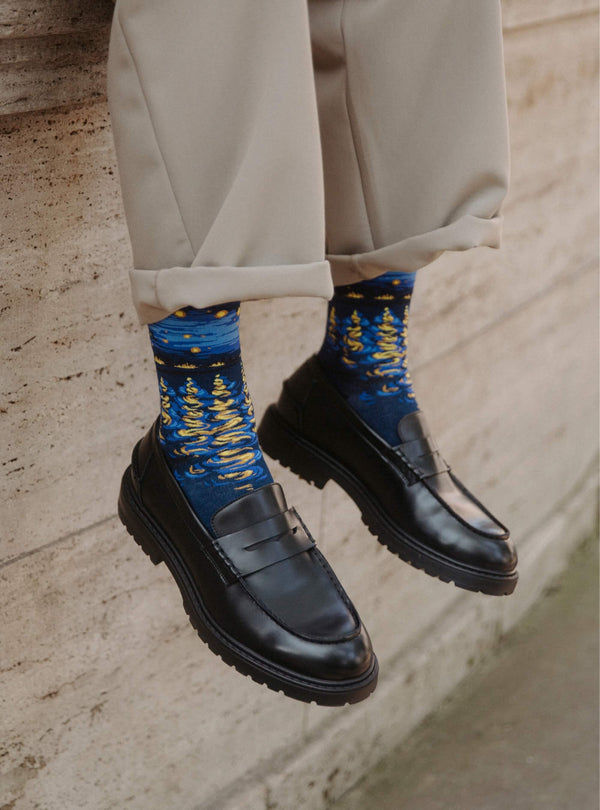
The most famous starry sky in the world belonged to someone from Rotterdam for 32 years. Now you can wear it round your leg, along with nine other paintings by Vincent.
The collection
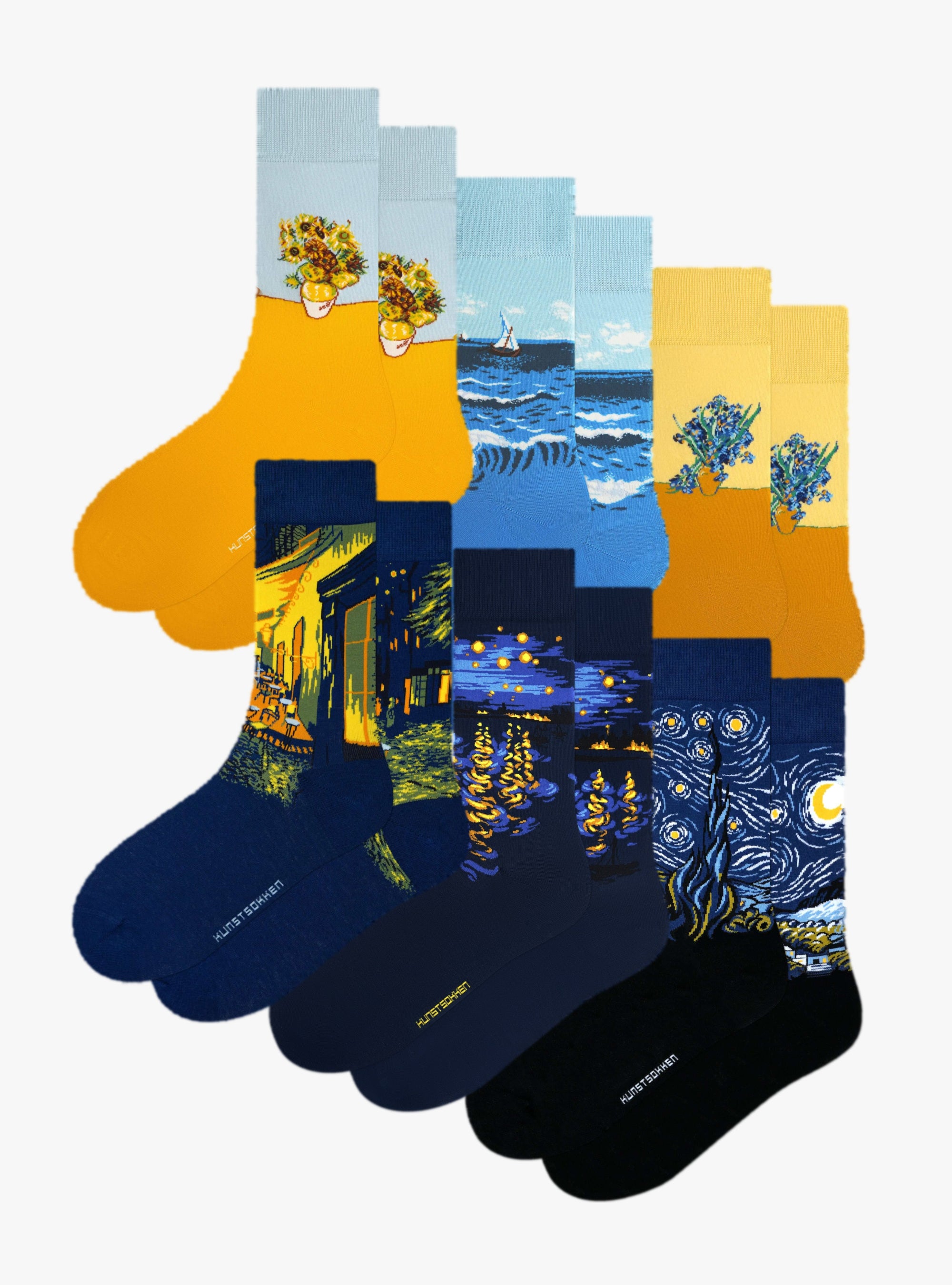
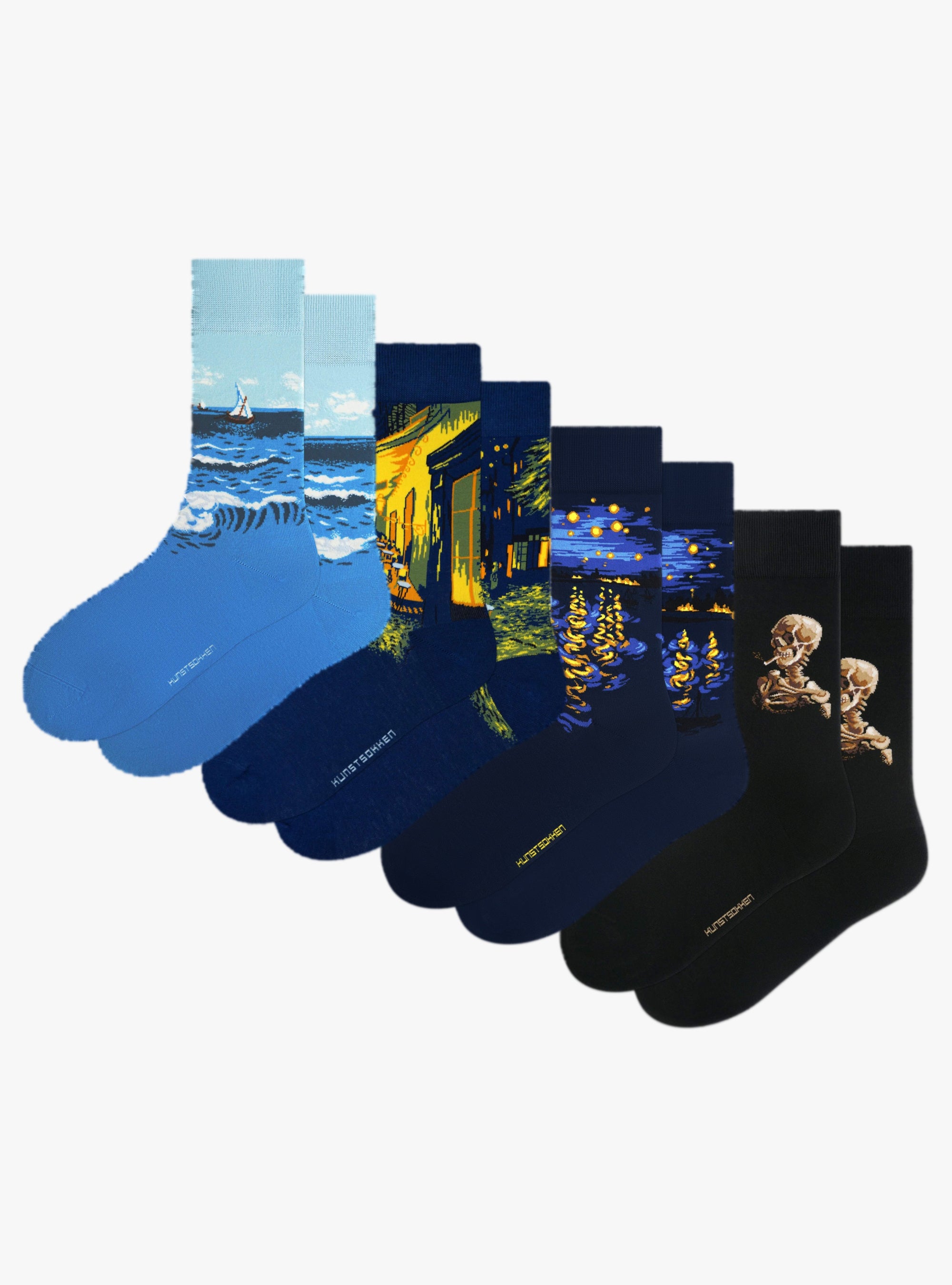
Ten paintings by Vincent, knitted into socks made of 80% organic cotton. Choose a set, or pick your favourite single pairs.
Each little square is a piece of the real sock, stitch by stitch. Click one to jump to that pair.
Sets
Most popular first




Single pairs
Autumn offerBuy 5 pairs, get 2 free. Single pairs count too, and you can mix them with other designs.




Who was Vincent?
He grew up in Brabant, in the south of the Netherlands, and only decided to become a painter when he was 27. In ten years he made more than 850 paintings. While he was alive, he sold very few of them. His brother Theo paid for the paint. Vincent wrote him lots and lots of letters: of the 820 letters we still have, 651 went to Theo.
“I can't help it if my paintings don't sell. But the day will come when people will see that they're worth more than the cost of the paint.”

Saint-Rémy · June 1889
The Starry Night
The view from his window, almost
For a while now, Vincent hasn't been feeling well in his mind. So in May 1889 he chooses to go and live in a hospital in Saint-Rémy. One morning, before the sun comes up, all he can see from his window is the morning star, the bright star of early morning. It looks very big.
He paints the picture in the daytime. He couldn't see the village from his window. He moved the cypress, the tall dark tree, closer. And the church tower looks more Dutch than French, says MoMA, the museum where the painting hangs today. From 1906 to 1938 it belonged to someone from Rotterdam.
“But once again I'm letting myself paint the stars too big.”

The Starry Night, 1889.

The swirling sky, at the top of the leg.

Midnight blue, with the swirling sky, the moon and the cypress around the leg. The foot is black.
View the sock
Saint-Rémy · February 1890
Almond Blossom
For a baby called Vincent
On 31 January 1890, Theo and Jo have a baby boy. They call him Vincent Willem, after his uncle. Vincent starts on a painting for their bedroom straight away.
At first it hung above the piano in their living room, and later in Bussum, in the bedroom of Jo and her son. They never sold it. That baby grew up and helped to start the Van Gogh Museum.
“Large branches of white almond blossom against a blue sky.”

Almond Blossom, 1890.

The blossom branches, around the leg.

Turquoise, with white blossom branches around the leg. The foot is turquoise.
View the sock
Les Saintes-Maries-de-la-Mer · June 1888
The Sea at Les Saintes-Maries
There's sand in the paint
Just over three months after moving to Arles, Vincent goes to the seaside for a few days. He paints the sea from the beach. We know that for sure: grains of sand have been found in the paint.
He spread the waves on with a flat little knife. He painted his name in red on purpose, like a red dot in all that green. He said the sea was the colour of a mackerel, a shiny fish: you never know if it's green, or purple, or blue.
“One night I took a walk by the sea, along the empty beach. It wasn't cheerful, but it wasn't sad either. It was beautiful.”

Seascape near Les Saintes-Maries-de-la-Mer, 1888.

Up close: every little square is a stitch.

Sea blue, with the waves and the white sail around the leg. The foot is plain blue.
View the sock
Arles · September 1888
Starry Night Over the Rhône
The starry sky at last
At the end of September 1888, two weeks after the Café Terrace, he stands by the River Rhône. He writes to Theo that at last he has painted the starry sky, at night, under a gas lamp. At the front, a couple in love are out for a walk.
In 1889 Theo hung it in a big art show in Paris. It was one of the first paintings by Vincent that people ever got to see. Later it belonged to someone from Bussum for seventeen years.
“The sky is blue-green, the water is royal blue, the land is lilac.”

Starry Night (over the Rhône), 1888.

Up close: every little square is a stitch.

Dark blue, with the stars and the golden lights in the water around the leg.
View the sock
Arles · August 1888
Sunflowers
Twelve flowers for a friend
Vincent is waiting for the painter Paul Gauguin, who is coming to live with him in the Yellow House in Arles. He wants to fill his studio, the room where he paints, with sunflowers.
He planned twelve sunflower paintings and made five big ones. They now hang in Amsterdam, Munich, London, Tokyo and Philadelphia. This sock comes from the painting in Munich: twelve flowers against light blue. Light on light, he wrote. He hoped this one would be the best.
“At the moment I'm working on a bunch of 12 sunflowers in a yellow clay pot.”

Sunflowers, 1888. Neue Pinakothek, Munich.

Two vases, at the top of the leg.

Sunflower yellow, with two vases of sunflowers against light blue at the top of the leg. The foot is yellow.
View the sock
Antwerp · early 1886
Skull with a Burning Cigarette
A joke at art school
In January 1886 Vincent starts at the art school in Antwerp. There, you have to draw skeletons. Painting a skeleton with a burning cigarette between its teeth is not part of the lesson.
The Van Gogh Museum calls it a joke, made between or after lessons. The little painting is only 32 by 25 centimetres. And at least he knew exactly what a skeleton looks like.
“Damn it, not one of them has any feeling for what an ancient statue is.”

Head of a Skeleton with a Burning Cigarette, 1886.

Up close: every little square is a stitch.

Black, with the smoking skull twice around the leg. The foot is plain black.
View the sock
Arles · September 1888
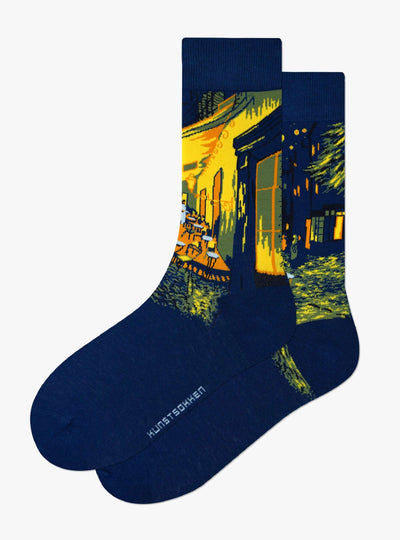
Café Terrace at Night
His first starry sky
One evening, on a square in Arles, Vincent sets up his easel, the wooden stand his painting rests on. He stands under the café's big lamp and paints right there, in the dark. That's because colours look different at night.
It's his first starry sky. The sky matches the real night of 16 or 17 September 1888, says the Kröller-Müller Museum.
“Here's a painting of the night, without black.”

Café Terrace at Night (Place du Forum), 1888.

Up close: every little square is a stitch.

Midnight blue, with the yellow terrace and the stars around the leg. The foot is midnight blue.
View the sock
Saint-Rémy · September 1889
Self-Portrait
Painting yourself isn't easy either
Vincent has only just got better. He was very ill for a while. He has nobody else to paint, so he paints himself. He is wearing a suit, not the jacket he usually painted in.
He thought he looked healthier than in his portraits from Paris, much healthier even. The curly lines in the background carry on into his hair and his beard.
“People say it's hard to know yourself. But it's not easy to paint yourself either.”

Self-Portrait, 1889.

Up close: every little square is a stitch.

Light blue, with his portrait twice around the leg, among the swirls.
View the sock
Saint-Rémy · summer 1889
Wheat Field with Cypresses
Painted three times, once for his mother
Vincent couldn't stop looking at the cypresses, the tall dark trees of the south of France. He wanted to paint them the way he had painted his sunflowers. Nobody had ever painted them the way he saw them.
At the end of June he painted this wheat field outdoors, in the mistral, the strong cold wind of the south of France. In September he painted it again in his room. After that came one more small version, for his mother and his sister.
“Its lines and shape are so beautiful, like an Egyptian obelisk.”

Wheat Field with Cypresses, 1889. The Met, New York.

Up close: every little square is a stitch.

Wheat yellow, with the cypresses and the swirling clouds around the leg. The foot is yellow.
View the sock
Saint-Rémy · May 1890
Irises
They used to be purple
In his last weeks in Saint-Rémy, Vincent paints two big bunches of irises. One against pink, soft and calm. And this one, against bright lemon yellow.
Take another look at your sock. The irises were actually purple, but the red in the paint has faded over the years. That's why they look blue now. That same month, Vincent moved to Auvers, a village near Paris.
“Colours that make each other stronger, because they are so different.”

Irises, 1890.

Two bunches, at the top of the leg.

Ochre yellow, with two bunches of irises at the top of the leg.
View the sock

The woman who made him famous
Vincent died in July 1890. He was 37. Half a year later, Theo died too. Theo's wife Jo was 28 and had a baby. Now she had hundreds of Vincent's paintings. In Bussum she opened a guest house, a home where guests could stay and eat. In 1905 she showed more than 480 of Vincent's works at the Stedelijk Museum in Amsterdam. In 1914 she made a book of his letters. The whole world knows Vincent today because of her.
Back to the socksPaintings: public domain, via the museums and Wikimedia Commons. The letters: vangoghletters.org. The knitted bands come from the socks' real knitting files.